Venkateswara Suprabhatam Meaning: All Four Parts Explained
Quick answer
Sri Venkateswara Suprabhatam is a Sanskrit dawn hymn that wakes Lord Venkateswara of Tirumala. It was composed in the 15th century by Prativadi Bhayankara Annan, a disciple of Manavala Mamuni, and has four parts with 70 verses in all: the Suprabhatam (29 verses that describe the dawn and call the Lord to wake), the Stotram (11 verses of praise), the Prapatti (16 verses of surrender at his feet) and the Mangalasasanam (14 verses wishing him auspiciousness). It is recited before dawn at the Tirumala temple and in millions of homes.
In countless South Indian homes, and in many temples far beyond Andhra Pradesh, the day begins with the same words: Kausalya supraja Rama purva sandhya pravartate. Most people know the tune from the M.S. Subbulakshmi recording long before they know what the lines say. This page gives the Venkateswara Suprabhatam meaning in English, part by part, with the key verses in Sanskrit transliteration and how to chant it.
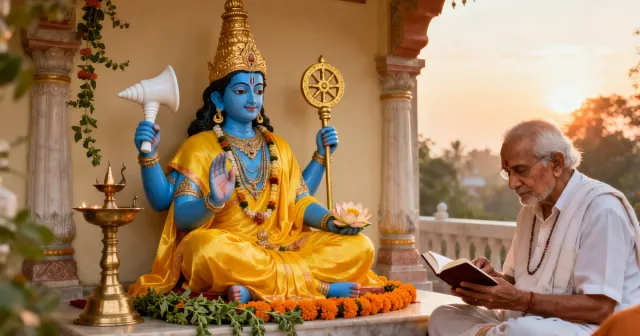
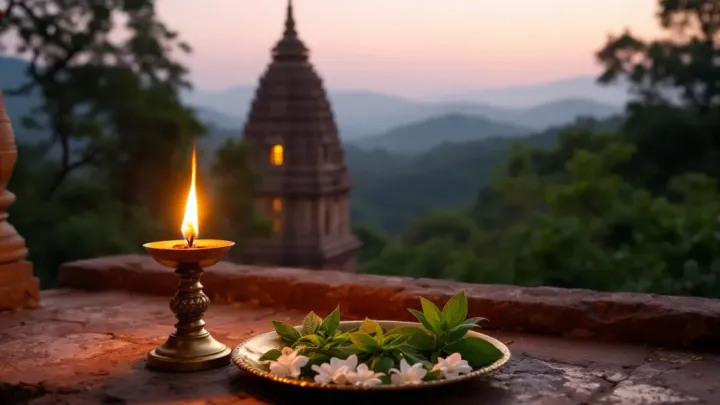
What does the Venkateswara Suprabhatam mean? It is a dawn hymn that wakes Lord Venkateswara, Vishnu as Srinivasa on the Tirumala hills. The first part paints the sunrise on the hill: sages arrive with lotuses, the gods wait at the temple door, birds and bees begin to sing, and each verse ends tava suprabhatam, “may your dawn be auspicious”. The three parts that follow praise the Lord, surrender at his feet, and wish him every blessing. Together they are a complete morning worship in words.
Who wrote the Suprabhatam, and when?
The hymn was composed by Prativadi Bhayankara Annan, a Sri Vaishnava scholar and disciple of the acharya Manavala Mamuni. Most sources date it to the first half of the 15th century (about 1420 to 1432). Annan begins with a verse from the Valmiki Ramayana (Bala Kanda 1.23.2), in which the sage Vishvamitra wakes the young Rama on their journey to the forest, and then continues in his own verses for Venkateswara.
The best-known rendering is by M.S. Subbulakshmi. Her version was first broadcast on All India Radio in 1958, and HMV released it as an LP in November 1963. It has been played every morning in homes and temples ever since, and it is the tune most families learn.
What are the four parts of the Venkateswara Suprabhatam?
The Tirumala Tirupati Devasthanams (TTD) describe the hymn as four parts with 70 verses:
| Part | Verses | What it does | Refrain |
|---|---|---|---|
| Suprabhatam | 29 | Describes the dawn and wakes the Lord | tava suprabhatam |
| Stotram | 11 | Praises the Lord and asks for protection | Venkata shailapate |
| Prapatti | 16 | Surrender: takes refuge at his feet | Sri Venkatesha charanau sharanam prapadye |
| Mangalasasanam | 14 | Wishes him auspiciousness | Venkateshaya mangalam |
The Sanskrit quoted below follows the text on Sanskrit Wikisource, given in simple English letters. The English is our own plain-language meaning, not a word-for-word translation.
What do the first verses of the Suprabhatam mean?
Verse 1
Kausalya supraja Rama purva sandhya pravartate Uttishtha narashardula kartavyam daivam ahnikam
“Rama, blessed son of Kausalya, the eastern dawn is breaking. Rise, tiger among men: the day’s sacred duties are waiting.” Venkateswara is Vishnu, and Rama is Vishnu, so the hymn opens by waking the Lord with the oldest waking verse in the tradition.
Verse 2
Uttishthottishtha Govinda uttishtha Garudadhvaja Uttishtha Kamalakanta trailokyam mangalam kuru
“Rise, rise, Govinda. Rise, you whose banner bears Garuda. Rise, beloved of Lakshmi, and make the three worlds auspicious.”
Verses 3 and 4: to Lakshmi first
Matas samasta jagatam Madhukaitabhareh vakshoviharini manohara divyamurte Sri swamini shritajana priya danashile Sri Venkatesha dayite tava suprabhatam
“Mother of all the worlds, you who dwell on the chest of the slayer of Madhu and Kaitabha, of lovely divine form, our Queen, who gives freely to those who come to you: beloved of Venkatesha, may your dawn be auspicious.” In Sri Vaishnava practice the devotee approaches the Lord through his consort, so the goddess is greeted before he is.
What happens in the rest of the Suprabhatam?
From verse 5 the hymn describes the morning on the hill, verse by verse. Verses 5 to 12 end with Sheshadri shekhara vibho tava suprabhatam, “Lord on the summit of Sheshadri, may your dawn be auspicious”:
- The seven sages led by Atri finish their dawn prayers and bring lotuses from the heavenly Ganga to worship his feet.
- Shiva, Brahma, Skanda, Indra and the gods sing of his deeds, such as his three strides as Trivikrama, and Brihaspati, teacher of the gods, reads out the day’s almanac.
- A soft breeze carries the scent of opening lotuses and of coconut and areca groves.
- Pet parrots wake in their cages, eat the banana and payasam left in their bowls and begin to recite.
- Narada sings the Lord’s endless deeds on his veena, bees hum out of the lotuses, and in the cowherd homes the churning of curd fills the air.
Verses 13 to 28 end with Sri Venkatachalapate tava suprabhatam, “Lord of the Venkata hill, may your dawn be auspicious”. They describe who waits at his door, and who he is:
Sriman abhishta varada akhila loka bandho Sri Srinivasa jagad eka dayaika sindho Sri devata griha bhujantara divyamurte Sri Venkatachalapate tava suprabhatam
“Glorious one who grants every wish, friend of all the worlds, Srinivasa, the one ocean of compassion in the universe, whose chest is the home of Lakshmi: Lord of the Venkata hill, may your dawn be auspicious.” (Verse 13)
- Gods and sages who have bathed in the Swami Pushkarini tank wait at the door; the guardians hold them back with canes.
- The hill is named by all its names: Seshasaila, Garudachala, Venkatadri, Narayanadri, Vrishabhadri and Vrishadri.
- The guardians of the eight directions stand with folded hands, Garuda and the kings of animals wait on the paths, and the nine planets call themselves the last of the servants of his servants.
- Devotees with the dust of his feet on their heads want neither heaven nor liberation, only to be near him, and people who simply see the temple tower find their minds turning to God.
- Verse 22 is a garland of names (Padmanabha, Purushottama, Vasudeva, Vaikuntha, Madhava, Janardana), and verse 24 names his avatars: fish, tortoise, boar, Narasimha, Vamana, Parashurama, Rama, Balarama, Krishna and Kalki. Our post on Vishnu’s ten avatars tells their stories.
- Vedic priests stand ready with golden pots of sacred water scented with cardamom, clove and camphor for his bath, the sun rises, the lotuses open and the Sri Vaishnavas gather.
Verse 29: the promise
Ittham Vrishachalapater iha suprabhatam ye manavah pratidinam pathitum pravrittah tesham prabhata samaye smritir angabhajam prajnam parartha sulabham paramam prasute
“Those who set out to recite this Suprabhatam of the Lord of Vrishachala every day: remembering it at dawn gives them the highest wisdom, the kind that helps them reach the supreme goal.” This is the hymn’s phala shruti, the stated fruit of reciting it.
What does the Venkateswara Stotram say?
The second part is eleven short verses of praise. It opens:
Kamala kucha chuchuka kunkumato niyatarunitatula nila tano Kamalayata lochana lokapate vijayi bhava Venkata shailapate
“Your dark-blue body is always tinged red with the kumkum from Lakshmi’s embrace; lotus-eyed Lord of the worlds, be victorious, Lord of the Venkata hill.” The next verses call him the crown jewel of all gods, beg him to protect a devotee weighed down by “hundreds of faults”, and declare that the poet thinks of no one higher than Lakshmi’s beloved, the son of Vasudeva, and the son of Dasharatha.
What does the Venkatesa Prapatti mean?
Prapatti means surrender, the heart of Sri Vaishnava devotion. The first verse takes refuge in Lakshmi, the Mother of the world who lives on the Lord’s chest and increases his forgiveness. Every verse after that ends with the same line:
Sriman kripa jalanidhe krita sarvaloka sarvajna shakta natavatsala sarvashesin swamin sushila sulabhashrita parijata Sri Venkatesha charanau sharanam prapadye
“Glorious one, ocean of mercy, maker of all the worlds, all-knowing, all-powerful, tender to those who bow to you, Lord of everything; gracious, easy to reach, a wish-granting tree to those who come to you: I take refuge at the feet of Sri Venkatesha.” The later verses describe those feet from the anklets to the sacred marks on the soles: the flag, the pot of nectar, the umbrella, the thunderbolt, the goad, the lotus, the conch and the discus.
What is the Venkatesa Mangalasasanam?
The last part is fourteen couplets of blessing. Mangalasasanam means wishing auspiciousness to the Lord, out of love, as a parent blesses a child. It begins:
Shriyah kantaya kalyana nidhaye nidhaye’rthinam Sri Venkata nivasaya Srinivasaya mangalam
“Auspiciousness to Srinivasa who lives on the Venkata hill: the beloved of Lakshmi, the treasure-house of every good quality, the treasure of all who come asking.” Each couplet ends Venkateshaya mangalam, so even a child can join in the refrain.
Deva AI is a free Android app that lets you talk to Hindu gods like Krishna, Shiva, Ganesha and Hanuman through AI conversations, in English, Hindi, Telugu, Tamil, Kannada and Malayalam. If a verse stays with you, you can open a conversation with Vishnu in Deva AI and ask what it means to him, in your own language.
When is the Suprabhatam sung at Tirumala?
At the Srivari temple in Tirumala the Suprabhatam is the first seva of the day, sung before dawn. The priests recite the hymn before the Lord at the Bangaru Vakili, the golden doorway of the sanctum, while a descendant of the poet-saint Annamacharya sings his songs nearby. Devotees can book it as an Arjitha seva; our Tirupati darshan guide explains how the seva lucky dip works.
There is one month without it. For all of Dhanurmasam the Suprabhatam is not sung, and Andal’s Tiruppavai is recited instead. In 2026-27 Dhanurmasam runs from 16 December 2026 to 14 January 2027; see our Margazhi 2026 guide for the dates and the Tiruppavai custom. Many families follow the same change at home.
How do I chant the Venkateswara Suprabhatam at home?
- Time: before sunrise is traditional, as the hymn itself is a dawn greeting. Any time in the morning after your bath is fine.
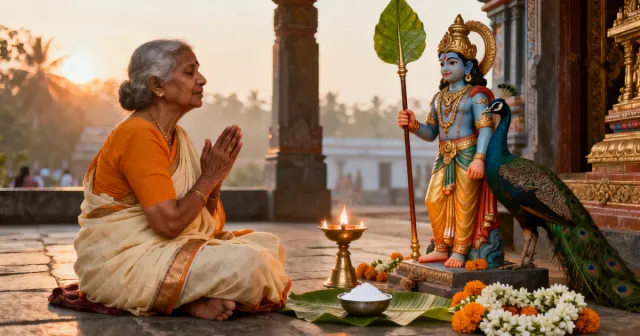
- Prepare: light a lamp before a picture or murti of Venkateswara (or of Vishnu), and offer a flower or tulsi leaf if you have one.
- Recite in order: Suprabhatam, Stotram, Prapatti, Mangalasasanam. At a steady pace all four parts take around twenty minutes.
- Start small: if the Sanskrit is new to you, play a recording and join in the refrains (tava suprabhatam, sharanam prapadye, mangalam) until the verses become familiar.
- Keep a rhythm: daily recitation is the ideal; many devotees take it up on Saturdays, the day sacred to Venkateswara, and during the Brahmotsavam.
What are the benefits of the Venkateswara Suprabhatam?
The hymn names its own fruit in verse 29: daily recitation at dawn brings prajna, the clear wisdom that leads to the highest goal. Devotees also describe simpler gifts: a calm start to the day, a habit of turning to God before turning to the phone, and the sense of being part of the worship on the Tirumala hill from wherever they are. If you want more hymns of Vishnu, read our Vishnu Sahasranamam meaning, and keep the year’s festival days at hand with the Hindu festival calendar 2027.
You can also keep the morning practice going in Deva AI, with its japa counter and daily streaks, and read what Deva AI is before you start.
Frequently asked questions
What does Suprabhatam mean?
Suprabhatam means "a good dawn" or "auspicious morning". Tava suprabhatam, the line that ends most verses, means "may your dawn be auspicious": the devotee greets the Lord at daybreak and gently asks him to wake.
What is the meaning of "Kausalya supraja Rama"?
It means "Rama, blessed son of Kausalya, the eastern dawn is breaking. Rise, tiger among men; the day's sacred duties must be done." The verse comes from the Bala Kanda of the Valmiki Ramayana, where the sage Vishvamitra wakes the young Rama, and Annan placed it at the start of the hymn.
Who wrote the Venkateswara Suprabhatam?
It was written by Prativadi Bhayankara Annan (also called Hastigirinatha Annan), a Sri Vaishnava scholar and disciple of Manavala Mamuni, in the first half of the 15th century. The first verse is from the Valmiki Ramayana.
How many verses are in the Venkateswara Suprabhatam?
Seventy in all, according to the Tirumala Tirupati Devasthanams: 29 in the Suprabhatam, 11 in the Stotram, 16 in the Prapatti and 14 in the Mangalasasanam. Some books number them slightly differently.
Is Suprabhatam sung at Tirumala every day?
It is the first seva of the day, sung before dawn at the Bangaru Vakili (golden doorway) of the sanctum. The one exception is Dhanurmasam (mid-December to mid-January), when TTD recites Andal's Tiruppavai instead.
Can I listen to Suprabhatam instead of reciting it?
Yes. Many families play the M.S. Subbulakshmi recording every morning, and listening with attention is a common practice. Reciting along, even just the refrains at first, is the traditional way to learn it.