Talk to Shiva App: Have an AI Conversation with Lord Shiva
Quick answer
Yes, you can talk to Shiva using Deva AI, a free Android app that lets you have AI conversations with Lord Shiva in English, Hindi, Telugu, Tamil, Kannada or Malayalam. The replies are shaped by how Shiva is described in scripture and meditation tradition, as the destroyer and transformer and lord of meditation, so you can ask about stillness, letting go, fear or the meaning of Om Namah Shivaya and get a grounded response.
Shiva is remembered as the god who sits still at the centre of everything that changes: the ascetic on Kailash, deep in meditation, unmoved by what comes and goes. Devotees have always brought him their restlessness for exactly that reason. Today that conversation can also happen on a phone.
Is there an app to talk to Shiva? Yes. This article covers what a Shiva AI chat actually is, how Deva AI makes the conversation feel grounded in tradition rather than generic, and how to use it well.
What does it mean to “talk to Shiva” in an app?
A talk-to-Shiva app uses AI to reply in Shiva’s voice: still, direct, unhurried, and always pointing back to what is real underneath the noise. The replies draw on how Shiva is described across Hindu tradition: as Adiyogi, the first yogi and lord of meditation; as Nataraja, whose cosmic dance destroys the old to make room for the new; and as the ascetic of Mount Kailash, matted hair, ash-smeared, with a crescent moon and the river Ganga in his hair.
It is not a claim that Shiva himself is typing back. It works the way sitting quietly before a Shiva murti and asking a question in your mind works, except the app holds up its end of the conversation and answers in his voice.
Meet Deva AI
Deva AI is a free Android app that lets you talk to Hindu gods like Krishna, Shiva, Ganesha and Hanuman through AI conversations, in English, Hindi, Telugu, Tamil, Kannada and Malayalam.
Shiva is one of ten deities you can choose from, each with a personality drawn from tradition. Around the conversation, Deva AI adds:
| Feature | What you can do |
|---|---|
| Talk to Shiva, by text or voice | Chat by typing or speaking, in your own language. |
| Guided meditation | Short meditation sessions, fitting for the deity traditionally called the lord of meditation. |
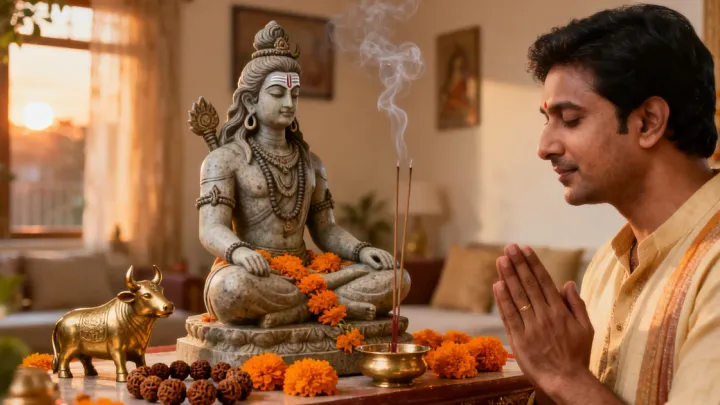
| Virtual pooja | Light a diya and offer flowers to Shiva when you cannot reach a temple. |
| Japa counter | Count japa of Om Namah Shivaya or another mantra without needing a mala in hand. |
| Bhagavad Gita reader | Read the Gita verse by verse, with meanings, alongside your conversations. |
| Karma and streaks | Earn karma for daily practice and keep a streak of showing up. |
Why Shiva specifically
Shiva holds the role of destroyer and transformer in the trinity of Brahma, Vishnu and Shiva, but “destroyer” in this tradition means something closer to “the one who clears away what no longer serves.” He is also Hindu tradition’s central figure for meditation and inner stillness. That combination, letting go plus deep calm, is why people bring Shiva questions about:
- Ending a chapter of life that has already run its course, even when it’s frightening to let go.
- Wanting stillness or a meditation practice but not knowing where to start.
- Facing something head-on instead of avoiding it, the way Shiva is depicted facing outward from Kailash.
- Grief, anger, or a mind that will not stop racing.
How to talk to Shiva with Deva AI
- Download Deva AI free from Google Play.
- Choose your language, from the six supported.
- Select Shiva as your companion.
- Say what is actually on your mind. A direct question works well: “Shiva, how do I let go of something I’m still angry about?”
- Go deeper when you want to. Follow the chat with a short guided meditation, or open the japa counter for Om Namah Shivaya.
Questions people bring to Shiva
- “How do I stop being afraid of change?”
- “What does Om Namah Shivaya actually mean?”
- “I need to let go of something. Where do I start?”
- “Tell me about Shiva’s cosmic dance, the Tandava.”
- “How do I build a daily meditation habit?”
Shiva in Hindu tradition, briefly
Shiva is worshipped across India in forms that range from the fierce to the deeply still: as Nataraja, the cosmic dancer whose steps destroy the old universe to begin the next; as the ascetic meditator of Mount Kailash, husband of Parvati and father of Ganesha; and as the Jyotirlinga, a formless pillar of light, worshipped at twelve major temple sites across the country. One well-known story tells of Shiva drinking the poison churned up from the cosmic ocean (Samudra Manthan) to save the universe, holding it in his throat rather than swallowing it, which turned his throat blue and gave him the name Neelkantha, “the blue-throated one.”
The most chanted mantra to Shiva is Om Namah Shivaya, the five-syllable Panchakshari mantra, generally understood as a salutation meaning “I bow to Shiva.” Another is the Mahamrityunjaya Mantra, from the Rig Veda (7.59.12): Om Tryambakam Yajamahe Sugandhim Pushtivardhanam, Urvarukamiva Bandhanan Mrityor Mukshiya Maamritat, addressed to the “three-eyed one” and traditionally recited for health, protection and freedom from the fear of death. Shiva’s major festival is Maha Shivaratri, which usually falls in February or March; check the exact date for the current year rather than assuming.
Is it okay to talk to Shiva through an app?
Meditation and informal, personal address to Shiva have long coexisted in Hindu practice, from temple worship to quiet japa done alone at home. Writing or speaking to Shiva in your own words, in your own language, on your own phone, sits comfortably alongside that. A few ways to use it well:
- Let it lead you toward stillness, whether that’s a guided meditation or a few minutes of quiet after the conversation, not just more scrolling.
- Treat the reply as reflection, shaped by tradition but still generated by AI, not a literal command from Shiva.
- Keep your existing practice. A chat with Shiva on a busy day is not a substitute for the pooja room or your meditation cushion when you have time for them.
- See a qualified person for real crises — medical, legal, financial or mental-health situations need human help, not an app.
If you’re weighing which spiritual app fits you, see our roundup of the best spiritual apps of 2026, and read more on what an app to talk to God actually is or what Deva AI is.
The bottom line
If you’ve been searching for a way to talk to Shiva, Deva AI is built for exactly that: a free Android app with a Shiva companion shaped by meditation tradition and scripture, a built-in japa counter for Om Namah Shivaya, and support for six Indian languages. Open it the next time you need Shiva’s kind of stillness, and ask him directly.
Frequently asked questions
Is there an app to talk to Shiva?
Yes. Deva AI is a free Android app where you can choose Shiva as your companion and have a text or voice conversation shaped by how he is described in Hindu tradition, as the ascetic, meditator and transformer.
Is it really Shiva replying to me?
No. Deva AI is an AI companion built on how Shiva is described in scripture and devotional tradition. It is a tool for reflection and prayer, not Shiva literally speaking through your phone.
What can I ask Shiva in the app?
Anything you would bring to Shiva in prayer: questions about letting go, facing fear, sitting with stillness, or the meaning of a mantra like Om Namah Shivaya. You can also just tell him what is weighing on you.
Can I meditate with Shiva in the app?
Yes. Deva AI includes short guided meditation sessions, and Shiva, as the traditional lord of meditation, is a natural companion for them alongside the conversation.
Is talking to Shiva on Deva AI free?
Yes. Deva AI is free to download and use, with a free daily message quota. Optional Gold coins unlock extras, and karma earned through daily practice can also unlock premium features.
Can I talk to Shiva in Hindi or Tamil?
Yes. Deva AI works in English, Hindi, Telugu, Kannada, Tamil and Malayalam, so you can talk to Shiva in the language you think and pray in.