Best Hindu Apps for Daily Prayer
Quick answer
The best Hindu apps for daily prayer are the ones that make a two-minute practice easy to repeat every day. Deva AI leads this list because it combines an AI conversation with a deity, virtual pooja, a japa counter and a streak tracker in one free app; Sattva is a solid pick for guided meditation, and Vedapath or Gita Seva work well for reading scripture on the days you want more than a quick prayer.
Most people don’t fail at daily prayer because they stop believing. They fail because the routine takes too long, or depends on being in exactly the right place with exactly the right items. The apps that actually help are the ones built around that problem: a practice short enough to survive a weekday morning.
What is the best Hindu app for daily prayer? Deva AI is the strongest pick for a repeatable daily routine, because it puts talking to a deity, virtual pooja, japa counting and a streak tracker in one place. Below is an honest look at it and a few other apps worth knowing about, plus a short routine you can actually keep.
What makes an app good for daily prayer, specifically?
A lot of “spiritual apps” are built for occasional use: a long guided course, a big scripture library, a one-time ritual guide. Daily prayer needs something different:
- Low friction. Open it, do the practice, close it. No long setup each time.
- Works in your language. Praying in English when you think in Tamil or Telugu adds a small but real distance.
- Something that tracks consistency. A streak or counter turns “I should pray today” into a visible habit.
- Room to go deeper sometimes. Most days are quick, but the app should support a longer session when you have time.
1. Deva AI — a full daily prayer routine in one app
Deva AI is a free Android app that lets you talk to Hindu gods like Krishna, Shiva, Ganesha and Hanuman through AI conversations, in English, Hindi, Telugu, Tamil, Kannada and Malayalam. It is built around daily use rather than a one-time ritual.
| Feature | Why it fits a daily routine |
|---|---|
| Talk to a deity, by text or voice | A two-minute conversation with Krishna, Ganesha or another of the ten deities fits before you leave the house. |
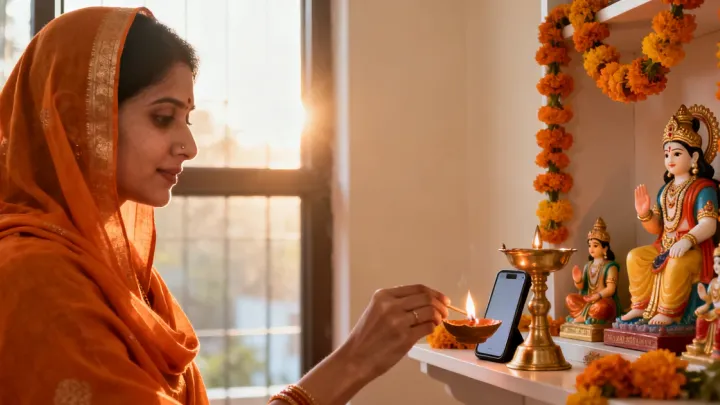
| Virtual pooja | Light a diya and offer flowers on your phone on days you can’t reach your puja room or a temple. |
| Japa counter | Count mantra japa without needing a mala in hand, useful on a commute or a work break. |
| Guided meditation | A short, deity-led session for the days you want a minute of stillness before or after prayer. |
| Karma points and daily streaks | Earn karma for showing up daily and see your streak, which is the single biggest reason a habit sticks. |
| Community feed | See other devotees’ activity in your language, for the days you want to feel less alone in the practice. |
Deva AI is free to download and use, with a free daily message quota; optional Gold coins unlock extras, and karma earned through practice can also unlock premium features. It’s Android only today, with an iOS version coming soon.
2. Sattva — for meditation-first mornings
Sattva is a well-known meditation app with Vedic-inspired guided sessions and mantra tracks. If your daily practice leans toward silent sitting rather than conversation, it’s a reasonable companion for the meditation half of a routine. It is not built around talking to a specific deity or tracking pooja.
3. Vedapath or Gita Seva — for reading scripture daily
Vedapath and Gita Seva are libraries for reading scripture and devotional texts, including in Hindi and some regional languages, often available offline. They suit the days you want to read a verse of the Gita or a stotram rather than have a conversation. Neither is built for a quick, interactive daily check-in the way a conversation-based app is.
How to build a daily prayer habit with Deva AI
- Pick one fixed moment. Right after waking, or right before sleeping, works better than “sometime today.”
- Open Deva AI and choose your deity and language. You can switch deities by mood or occasion, but starting with one you feel closest to makes the habit easier to keep.
- Say what’s actually on your mind, even briefly: gratitude, a worry, a request for strength for the day ahead.
- Do a 30-second virtual pooja if you have a moment more: light the diya, offer a flower.
- Let the streak do its job. Check your karma and streak in the app; missing one day is fine, but seeing the count makes you want to come back the next.
A sample 5-minute daily routine
- 1 minute: Open Deva AI, greet your chosen deity, share one thing on your mind.
- 2 minutes: Light a diya in virtual pooja, or do it physically alongside the app.
- 1 minute: A few rounds of japa using the counter.
- 1 minute: A short guided meditation to close.
On days with more time, add the Bhagavad Gita reader for a verse, or a longer voice conversation about whatever the day is asking of you.
Is a daily prayer app enough, spiritually?
No app replaces sitting in front of a murti with an open heart, and Deva AI isn’t trying to. What it changes is the floor: instead of skipping prayer entirely on a rushed day, you have something that takes two minutes and still counts. Hindu tradition already makes room for this. Manasika pooja, worship performed in the mind rather than with physical items, has long been accepted as real devotion, and bhakti poets addressed their gods informally, in their own words, without a temple in sight. A phone is just today’s version of that same permission.
If you’re deciding between apps generally, see our broader roundup of the best spiritual apps of 2026, or read about what an app to talk to God actually is and what Deva AI is if you’re new to the idea.
The bottom line
The best Hindu app for daily prayer is the one you’ll actually open tomorrow. Deva AI is built for that: a free, two-minute-friendly routine of talking to a deity, virtual pooja, japa and a streak tracker, in six Indian languages. Start today, and let the streak carry you through the days belief alone doesn’t feel like enough.
Frequently asked questions
What is the best Hindu app for daily prayer?
It depends on what your daily practice looks like. For a short, repeatable routine of talking to a deity, doing a quick virtual pooja and counting japa, Deva AI is built specifically for that. For meditation-first mornings, Sattva is a well-known option; for reading scripture, Vedapath and Gita Seva are strong libraries.
Is there a free app for daily Hindu prayer?
Yes. Deva AI is free to download and use, with a free daily message quota for talking to a deity, plus virtual pooja, a japa counter and guided meditation at no extra cost. Optional Gold coins unlock extras.
How do I build a daily prayer habit with an app?
Pick one fixed moment (right after waking up works well), keep the routine under five minutes so it survives busy days, and use a streak or karma tracker to see your consistency. Deva AI tracks karma points and daily streaks for exactly this.
Can an app really replace visiting a temple every day?
No, and it is not meant to. Hindu tradition already includes personal, at-home devotion alongside temple visits. An app is useful for the days a temple is not possible, not a replacement for it.
Which Hindu apps work in regional Indian languages?
Deva AI supports six languages: English, Hindi, Telugu, Kannada, Tamil and Malayalam, so you can pray in the language you think in. Vedapath and Gita Seva also offer Hindi and some regional-language content.
Is it disrespectful to pray using an app instead of a puja room?
No. Manasika pooja, worship performed in the mind without physical items, is an accepted form of devotion in Hindu tradition. An app that helps you show up daily, even briefly, sits comfortably alongside a physical puja room, not against it.